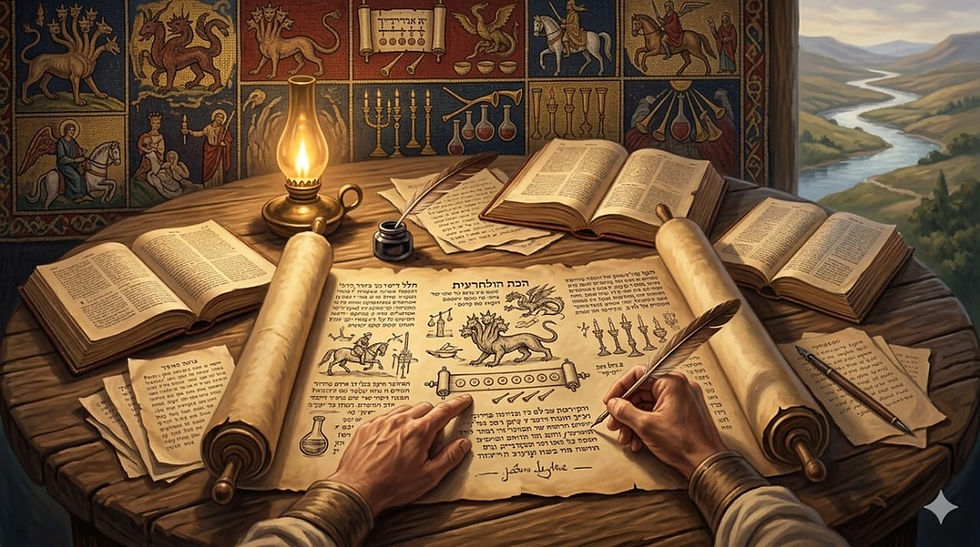

The meaning of the Four Horsemen of Revelation

Updated: May 7

The Meaning of the Four Horsemen of Revelation
Read Revelation 5 and 6
When we encounter the four horsemen of Revelation, several questions arise: Who are they? Do they represent real individuals who will appear in the future? When will they emerge? Or are they symbols of events that will take place on earth?
To understand their true meaning, we must respect the literary style of Revelation, which—unlike the book of Daniel, for example—does not aim to point to specific historical events. Instead, it reveals the spiritual battle taking place in the world, where kingdoms are influenced by Satan to oppose the people of God. It also shows what God’s people are subject to in this world and ultimately reveals the end of all things, where, despite all the suffering faced on earth, God’s people are already victorious and their final outcome will be triumphant.
Therefore, the message of Revelation does not necessarily follow a chronological order in its description of events. The visions in the book often overlap, and each one offers a different perspective on the same events throughout history. The opening of the third seal does not necessarily occur after the second. They are written sequentially simply because there is no other way to describe them all at once—the details must be presented separately so we can understand them.
The four horsemen appear in the vision of the opening of the seals; they are the first four of a total of seven seals. But before understanding the seals, we need to understand where they come from. In the previous chapter of Revelation, the seals are part of a scroll that only the Lamb was worthy to open. When we analyze the text, we see that the scroll represents a kind of title deed where Christ owns God’s people. The Lamb obtained the right to open it through His sacrifice on the cross of Calvary. The seals, as part of this scroll, represent what God’s people are subject to witness and even experience on earth—sufferings that are common to all humanity. The number seven indicates that these events are part of God’s sovereign plan, ensuring that His purposes are fulfilled.
The events associated with some of the seals may occur simultaneously—and in fact, many of them already do. Later in Revelation, in chapters 8, 9, and 11, we see the judgments of the seven trumpets. Unlike the events of the seals, which affect all people (including God’s people), the trumpet judgments represent partial judgments directed at those living in wickedness, with the purpose of calling them to repentance. The events of the seals and the trumpets can very well occur at the same time in human history. They belong to the past, present, and future. As we examine each seal, this understanding becomes clearer.
Regarding the four horsemen, the number four represents global scope—that is, something that affects the entire earth. In biblical times, people understood the world in terms of its four corners: north, south, east, and west (Isaiah 11:12), or even in four dimensions: height, depth, width, and length (Ephesians 3:18). In other words, no part of the earth is untouched by their activity. With this foundation in mind, let’s look at what each horseman represents.
The White Horse
With the breaking of the first seal, a rider appears on a white horse, holding a bow. He is given a crown and goes out conquering and to conquer. This rider is very likely the same one described in Revelation 19:11–16. In that passage, it becomes clear that he represents Jesus. Therefore, the opening of the first seal symbolizes Christ’s victory and the inauguration of the New Covenant. The color white represents His holiness and purity.
The Red Horse
With the breaking of the second seal, a rider appears on a red horse. He is given a sword and the power to bring war to the earth and cause people to kill one another. This horseman represents war and bloodshed, quite literally. The red color, associated with blood, reinforces this meaning. This has been happening since the beginning of human civilization and continues to this day. Wars are events that we, as the Church, continue to witness—and often suffer the consequences of.
The Black Horse
With the breaking of the third seal, a rider appears on a black horse, holding a pair of scales. Then John hears a voice saying:
“Two pounds of wheat for a day’s wages, and six pounds of barley for a day’s wages, and do not damage the oil and the wine.” (Revelation 6:6 – NIV)
In terms of interpretation, the scales represent buying and selling, while the black color is associated with famine. The prices described in this verse are extremely inflated, indicating the difficulty of obtaining food. The oil and wine remain untouched, which may point to economic inequality, as these items are associated with abundance. Overall, this seal points to periods of famine that humanity faces throughout history.
The Pale Horse
With the breaking of the fourth seal, a rider appears on a pale (yellowish) horse. This rider is called Death, and Hades follows him. He is given power over a fourth of the earth to kill by sword, famine, plague, and wild beasts. The meaning of this seal is quite clear on its own. Death is associated with the pale color, and the forms of death described are tragic, affecting a significant portion of humanity.
At this point, it is important to remember that the Church lives within the context of all these seals. And this is exactly what we see happening today: wars, pandemics, famine, and tragic deaths. Because we live within this reality, God’s people are often not immune to these hardships.
And here we come to the end of our study. If you’d like, feel free to leave your thoughts in the comments below. God bless you!


Comments