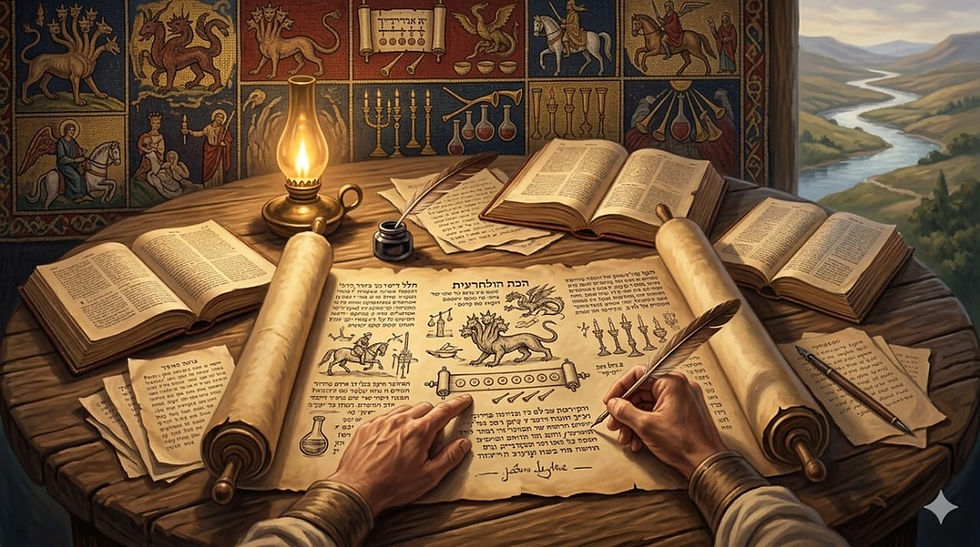

Who are the Beasts of Revelation 13?


Read Revelation 12:3–4; 13:1–15; and Daniel 2, 7, and 8.
The Beast from the Sea
In Revelation 13, we find the description of two beasts: one rising out of the sea and another rising out of the earth. This is not the first time the Bible describes beasts. In the book of the prophet Daniel, chapter 7 presents four beasts coming up out of the sea: one like a lion, another like a bear, another like a leopard, and a fourth with a terrifying appearance. Each has distinct characteristics and meanings. Later in the chapter, Daniel receives the explanation that these beasts represent kings or kingdoms—symbols of their power.
It is very likely that these kingdoms are the same ones described in Nebuchadnezzar’s dream, which portrays a succession of ancient empires. Accordingly, in Daniel, the first beast represents the Babylonian Empire, the second the Medo-Persian Empire, the third the Greek Empire, and the fourth the Roman Empire.
The description of the first beast in Revelation 13 is clearly inspired by the beasts in Daniel 7. Notice that its appearance is a composite of all four. The book of Daniel and the book of Revelation differ in literary style and purpose. Daniel is a prophetic book that points to specific historical events and their implications for God’s people. Revelation, on the other hand, has a structure similar to a dramatic narrative—almost like a theatrical work—and does not aim primarily to identify specific historical events. Instead, it reveals, in a broader sense, the spiritual battle taking place in the world, where Satan manipulates kings and kingdoms to oppose God’s plans and His people on earth.
Thus, in Revelation, the beast rising from the sea represents the empires of the Old Covenant era which, under Satan’s influence, rose up against God’s purposes and persecuted His people. In biblical symbolism, the sea often represents peoples and nations.
Why Seven Heads and Ten Horns with Crowns?
In biblical literature, certain numbers carry meanings beyond their literal value. The number seven signifies something created or ordained by God and represents the perfection of His plans. The number ten often represents a defined period of time with a beginning and an end. For example, the “ten days” mentioned in Revelation 2:10 do not necessarily refer to a literal ten-day period, but rather to a limited span of time. The unit “days” suggests a short duration; if “years” were used, it would indicate a longer period.
Regarding the beast, the heads symbolize power or governance, while the horns with crowns represent authority. In other words, the beast with seven heads and ten horns represents empires that rise on earth by God’s permission (hence the number seven), but whose authority is temporary and will come to an end in God’s perfect timing (hence the number ten).
Another important detail is that the beast’s appearance resembles the dragon described in Revelation 12. There, it is made clear that the dragon represents Satan. This indicates who stands behind these empires that rise up and persecute God’s people. Yet all of this occurs under God’s sovereign permission, so that His purposes may be fulfilled. When the appointed time is complete, Satan’s authority will also come to an end.
The Mortal Wound on One of the Heads
This wound represents the defeat Satan suffered when Jesus overcame him at the cross of Calvary. However, although this defeat is decisive, its full effects have not yet been completely realized.
At the cross, the Lord limited Satan’s power and, consequently, his influence over earthly empires. As a result, the nations now have the opportunity to receive the gospel of salvation, to be discipled, and to become part of God’s people. Even so, Satan still operates with limited power, raising up nations to oppose God’s plans and His people. This is why those who do not serve the Lord are often captivated by him.
The healing of the wound represents the continued activity of the Enemy. But when God’s sovereign purpose is fulfilled, Satan will be completely destroyed, and God’s people will be victorious forever. The forty-two months during which the beast is active correspond to three and a half years—half of seven—symbolizing a limited period that is yet to be completed.
The Beast from the Earth
The text then introduces another beast, this time rising from the earth. In Scripture, the earth—like the sea—can also symbolize peoples and nations. Notice that the characteristics of this second beast resemble those of the beast described in Daniel 8. This points to a succession of beasts—or, more precisely, empires—manipulated by Satan (which is why they speak like a dragon).
As we have seen, the beast from the sea represents empires that persecuted God’s people during the Old Covenant era. The beast from the earth represents empires, also influenced by Satan, that persecute God’s people during the New Covenant era. Its two horns symbolize authority and also echo the imagery found in Daniel.
Some associate the second beast specifically with the Antichrist—a figure who would oppose God in the final days before judgment. However, it is more consistent to understand this not as a single individual, but as the intensification of the spirit of the Antichrist in the world during the final stages of history. This manifestation will likely occur through various empires and ideologies that oppose the gospel of Christ. In fact, the activity of this second beast is already present in the world and, according to Scripture, will intensify as the end approaches.
The image that the second beast sets up in honor of the first represents not only idolatry, but also the revival of the same patterns of persecution and opposition practiced by ancient empires against God’s people. The signs (or miracles, in some translations) that the beast performs—such as calling fire down from heaven—symbolize the military power of these empires.
The text goes on to describe the name and the number of the beast, but that will be addressed in a future study.


Comments